Cessna Citation XLS for Sale: 2026 Market Study

Joseph Pennella
Founder and Principal Broker
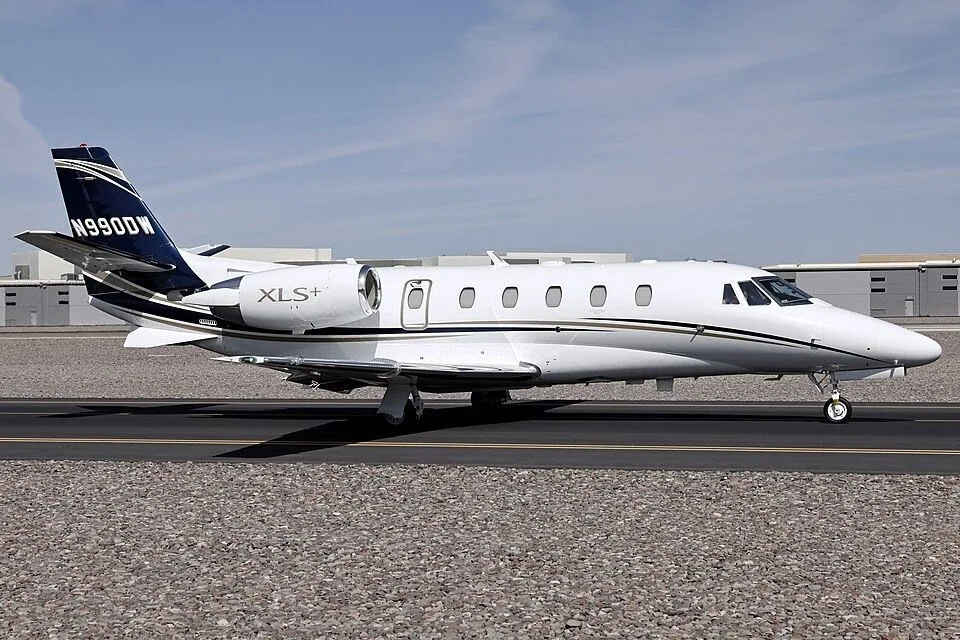
Photo: Duncan Kirk, CC BY-SA 4.0.
If you are looking for a Cessna Citation XLS for sale this autumn, there are five to choose from out of 293 in operation — 1.7% of the fleet (JETNET, November 10, 2026). That is the tightest availability we have reported on any type this year, and all five are on exclusive with a broker (JETNET, November 10, 2026).
A note on scope: these figures cover the 560XLS, built 2004 to 2009, 330 aircraft in total. JETNET tracks the earlier Excel and the later XLS+ as separate models, so neither is included here.
The airframe in brief
The XLS is the updated Excel, with Pratt & Whitney PW545B engines at 3,991 lb of thrust each and a higher-pressure core that allows hotter, more efficient operation (JETNET specifications). Typical configuration is two crew and eight passengers in a 422 cu ft cabin, with 90 cu ft of baggage. Range is 1,989 nm with four passengers and 1,539 nm with eight; FAA field length is 2,739 ft, and the ceiling is 45,000 ft (JETNET specifications). Engine TBO is 5,000 hours — remember that number.
Buyers choose it for the reason they always have: a midsize cabin that gets into short runways, flown by two pilots, at a cost per hour that a light jet owner can still recognize.
Fleet and availability
Of 330 built, 293 are in operation and 36 are retired or in storage (JETNET, November 10, 2026). The in-operation count has fallen from roughly 327 in 2022, and JETNET’s recent activity log shows eight airframes reclassified as written off or parted out since August alone. The parts market is actively consuming the bottom of this fleet.
Ownership splits 233 whole, 40 fractional and 20 shared (JETNET, November 10, 2026). That is a fifth of the fleet inside programs, and it shows in the operator data: NetJets alone flew 17,507 XLS flights in the last 365 days, with NetJets Europe adding 8,378 (JETNET, November 10, 2026). Fleet-wide there were 84,142 flights averaging 432 nm and 1.4 hours — this airplane is worked hard on short legs.
The fleet is 68.6% US-based, and four of the five for sale are in North America (JETNET, November 10, 2026).
The numbers that do not agree
Over twelve months, aircraft for sale fell from nine to five, down 44%. Average asking fell $1,298,000, down 31%. And average days on market rose 75 days to 141, up 114% (JETNET, November 10, 2026).
Less inventory, lower asking prices, and twice as long to sell. That combination needs explaining, and two things explain most of it.
First, the asking price figure is nearly meaningless right now. Four of the five listings show “Inquire” rather than a number, so the $4,200,000 average is a single aircraft (JETNET, November 10, 2026). The 31% “decline” compares one data point to another. Treat it as noise, not a trend.
Second, the aircraft still listed are the hard ones. Airframe times on the five run 4,777 to 6,785 hours with engine times of 4,932 to 6,719 — against a 5,000-hour TBO (JETNET, November 10, 2026). Most of this inventory is at or through a major engine event. JETNET’s feature data shows one aircraft each on ESP Gold, JSSI and Power Advantage Plus, and flags only two of five as ADS-B capable (JETNET, November 10, 2026). Those fields depend on what brokers enter, so verify on the aircraft — but the pattern is consistent with what sells fast and what sits.
Retail sales totalled 32 over twelve months, giving an absorption rate of 2.0 months (JETNET, November 10, 2026). Monthly sales have slowed through 2026: eight in November 2025 and seven in December, against one to four a month since.
What to check
Engine program and status. With TBO at 5,000 hours and listed aircraft at 4,932 to 6,719 engine hours, the next event is the deal. Confirm which program, whether it transfers, and hours to the next hot section and overhaul on both engines.
ADS-B and avionics compliance. Verify ADS-B Out, and price any gap in 8.33 kHz spacing, FM immunity or dual FMS before you sign.
The “Inquire” listings. Four of five have no published price. Get the logs reviewed before you pay for a pre-buy.
Program or charter history. A fifth of this fleet lives in fractional and shared programs, and high-cycle aircraft coming out of those have different wear than a private owner’s airplane. Landings on the listed aircraft run to 5,960.
Where the airframe sits against the part-out floor. Eight write-offs since August says the oldest, highest-time airframes are worth more in pieces. Know which side of that line you are buying on.
Who it suits
The XLS fits an owner flying 600 to 1,500 nm legs with six to eight people, often into shorter runways, who wants a real midsize cabin without large-cabin costs. JETNET’s model puts total direct operating cost at $2,891.75 per hour, with fuel at $1,873.41 of that, assuming $8.11 per gallon and a 231 gallon-per-hour burn (JETNET, November 10, 2026). Jet A averaged $8.36 nationally in September (iFlightPlanner, September 2026), so budget above the model.
Timing
Five aircraft, all on exclusive, with two months of absorption is not a market where a buyer dictates terms. But the inventory that exists is the inventory nobody wanted, and that is where a prepared buyer with a good pre-buy can do well. Start with the engine records. If a year-end closing matters to your planning, confirm with your advisor.
Joseph Pennella, Penn Jets LLC
Sources
JETNET, Citation XLS Market Report prepared for Penn Jets LLC, November 10, 2026 (fleet, availability, ownership, absorption, asking prices, days on market, features, listings, recent market activity, operator and utilization data, specifications and operating cost model)
iFlightPlanner monthly fuel survey, September 2026
General market information only; not tax or legal advice.