Dassault Falcon 900B for Sale: 2026 Market Study

Joseph Pennella
Founder and Principal Broker
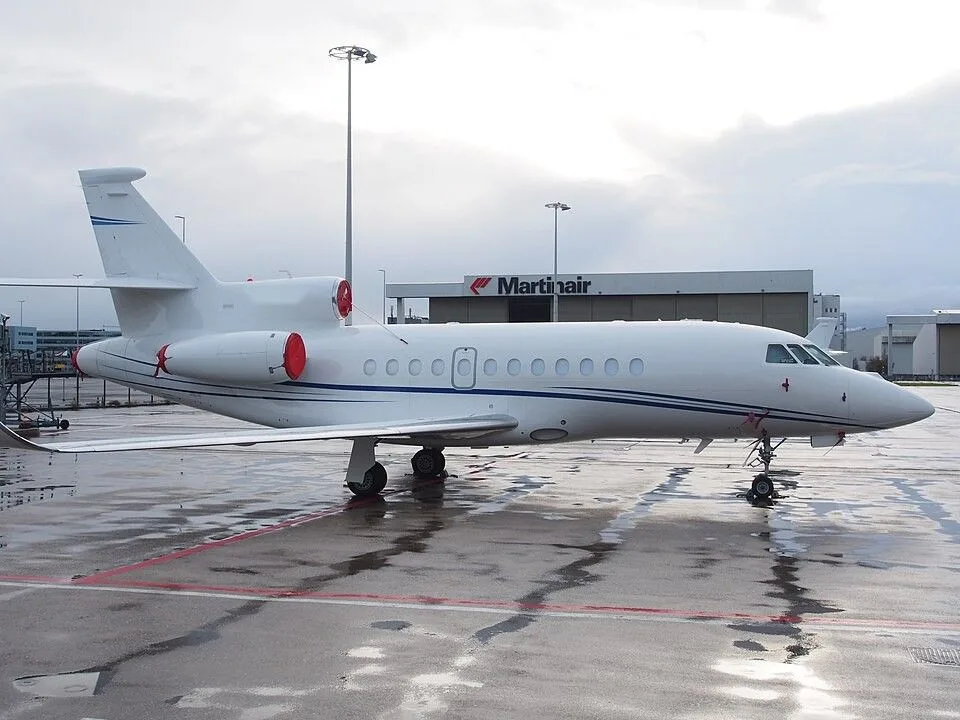
Photo: Alf van Beem.
If you are looking for a Dassault Falcon 900B for sale this autumn, there are 17 to choose from out of 162 in operation, which is 10.5 percent of the fleet (JETNET, October 28, 2026). That is a high share for a large-cabin jet, and the aircraft are taking 263 days on average to sell, up 106 days from a year ago (JETNET, October 28, 2026). This is a buyer's market with a catch: the airplanes that are easy to buy are the ones you should think hardest about.
A note on scope: JETNET tracks the original Falcon 900 and the 900B together, since the 900B is the 1991-and-later version of the same airframe with TFE731-5BR engines, and many early 900s have been converted. The figures below cover both.
The airframe in brief
The Falcon 900 is the three-engine Dassault that replaced the Falcon 50 at the top of the line. It first flew on September 21, 1984, was certified in 1986, and the 900B followed in 1991 with Honeywell TFE731-5BR-1C engines at 4,750 lb of thrust each and more range (Dassault, via Wikipedia). Production ran from 1984 to 2000 and totaled 177 aircraft before the 900C and 900EX took over (JETNET, October 28, 2026). The cabin is 33 ft 2 in long, 7 ft 7 in wide, and 6 ft 2 in high, typically 12 seats; range is 4,080 nm, and the sea-level balanced field length is 5,144 ft, short for an airplane this size (JETNET specifications). People buy it for the cabin, three-engine overwater comfort, and those runway numbers.
Fleet and availability
Of the 177 built, 162 are in operation and 15 are retired or in storage (JETNET, October 28, 2026). The in-operation count has slipped from 165 in 2022, and two 1994 airframes were reclassified as written off and parted out this year (JETNET market activity, June and October 2026). That matters: the parts market has started to set the floor under the oldest airframes. The fleet is 73.5 percent U.S.-based, and 16 of the 17 for sale are in North America; they are 1987 to 1996 models with 7,902 to 17,103 airframe hours, averaging 12,165 (JETNET, October 28, 2026). The 1988 model year is the heaviest, with 6 of 26 listed, and JETNET puts absorption at 20.5 months of supply (JETNET, October 28, 2026). Asking prices
Average asking is $5.14M, down $619,000 or 12 percent over twelve months, from a low of $3.999M on a 1989 to a high of $6.395M on a 1996 (JETNET, October 28, 2026). By model year, where sellers have published a number: 1987, $4.55M; 1988, $4.2M to $6.2M; 1989, $3.999M; 1996, $6.395M (JETNET, October 28, 2026). What sold tells a tighter story. Twelve retail sales closed in the last twelve months, with published asking from $4.9M on a 1989 to $6.7M on a 1992 (JETNET recent retail sales, October 28, 2026). Hours mattered more than year: sales between 10,000 and 11,000 hours averaged $5.65M asking, while those over 13,000 hours asked $5.395M (JETNET, October 28, 2026).
What moves and what sits
Engine programs decide this market. Of the 17 for sale, six are on MSP Gold, three on MSP, and two on Honeywell EAP, which leaves six with no coverage (JETNET, October 28, 2026). An uncovered aircraft facing a core zone inspection on three TFE731s is a seven-figure conversation, and those are the ones sitting past a year; days on market run from 13 to 579 (JETNET, October 28, 2026). The fast movers were sub-11,000-hour aircraft with program engines; the slow ones were high-time 1987 and 1988 airframes that changed hands at or near parts value. Only five of the 17 show FANS, CPDLC, or 8.33 kHz spacing (JETNET, October 28, 2026); those fields are only as complete as what brokers enter, so verify on the aircraft, but without FANS 1/A and CPDLC it is a domestic airplane now.
What to check
Engine program and status. Which program, whether it transfers, and hours and cycles to the next major periodic and core zone inspection on all three engines. Three uncovered TFE731s is the biggest single risk in the deal.
Airframe inspection cycle. Where the aircraft sits in the Dassault C-check sequence and who did the last one. A 2C coming due changes the price.
Avionics path. Collins Proline and SPZ-800 are original fit; get a quote on whatever is missing among ADS-B Out, FANS 1/A, CPDLC, and TCAS 7.1 before you sign.
Corrosion. These airframes are 30 to 40 years old; look at wing attach areas, the center tank, and the gear bays, and read the last two inspection reports, not the summaries.
The "inquire" trap. Ten of the 17 have no published price (JETNET, October 28, 2026). Treat a missing price as a missing fact and get the logs reviewed before you pay for a pre-buy.
Who it suits
The 900B fits an owner who wants a true wide cabin for eight to twelve people on 2,000 to 3,500 nm legs, is comfortable with three engines, and has $4M to $6.5M plus a serious maintenance reserve. Falcon 50 owners are the largest group moving up into the 900, and 900 owners most often move on to a 900EX (JETNET, compiled September 30, 2026). If you fly longer legs and want a newer airplane, the EX is the better buy. If the mission is mostly domestic with six people, a Falcon 50 or a Challenger 604 will do it for less. A 900B bought right, with program engines and current avionics, is still one of the best cabins per dollar in business aviation; one bought wrong is a parts airplane with a nice interior.
Timing
Twelve sales in twelve months, 17 listed, and asking prices down 12 percent say the market has moved to the buyer. The pressure is on sellers of high-time, uncovered aircraft, and that is where the real discounts are, if the pre-buy supports it. If a fourth-quarter closing matters to your planning, there is enough inventory to be selective; start with the engine records, and confirm with your advisor.
Joseph Pennella, Penn Jets LLC
Sources
JETNET, Falcon 900 Market Report prepared for Penn Jets LLC, October 28, 2026 (fleet, availability, asking prices, days on market, absorption, features, retail sales; buyer and owner model data compiled September 30, 2026)
Dassault Aviation, Falcon 900 program history, via Wikipedia, accessed October 28, 2026
General market information only; not tax or legal advice.